
Key takeaways
- Compare whole-window ratings in consistent units.
- Evaluate solar heat gain alongside room orientation and shading.
- Confirm the exact certified model and installation scope.
How to Compare Window Energy Ratings Before Winter
Two replacement windows can look almost identical and still perform differently. Before you compare quotes, ask for the energy-performance information for the exact window configuration being offered.
For Canadian homeowners, three useful terms are U-factor, solar heat gain coefficient (SHGC), and Energy Rating (ER). Understanding their roles helps you ask better questions without turning window shopping into an engineering project.
Start with the whole window
A glass package is only part of the product. Frame design, spacers, seals, and the size and operating style all belong in the discussion.
Ask whether the figures on a quote describe the complete window or only the centre of the glass. Compare equivalent information rather than treating a glass-only figure as the performance of the entire assembly.
The three numbers to understand
| Rating | What it describes | How to use it |
|---|---|---|
| U-factor | Heat transfer through the window assembly | Lower values indicate less heat loss; compare figures using the same units |
| SHGC | The fraction of solar energy admitted through the window | Consider it alongside orientation, shading, and summer comfort |
| ER | A Canadian rating balancing heat loss, solar gain, and air leakage | Use it with the individual ratings to understand the product |
Natural Resources Canada explains these measures in its ratings and certification guide. A higher ER and a lower U-factor describe different aspects of performance; one number does not tell the entire story.
U-factor: compare the units first
A lower U-factor means better resistance to heat loss through the assembly. However, Canadian and American documents may display different units. Numbers that appear dramatically different may describe similar performance when converted.
Your simplest next step is to ask the supplier to put all quoted U-factors in the same units. Also confirm the rated configuration: a picture window and an operable window should not be assumed to share the same result.
SHGC: think about the room, not just winter
Solar heat can be welcome in one room and uncomfortable in another. A large window exposed to afternoon sun raises different questions from a smaller shaded opening.
Describe the room to your supplier: which way it faces, whether it overheats, and what shades it. Ask how the proposed glass balances winter heat retention with summer solar control. Avoid choosing a glass package solely because its SHGC is the lowest available.
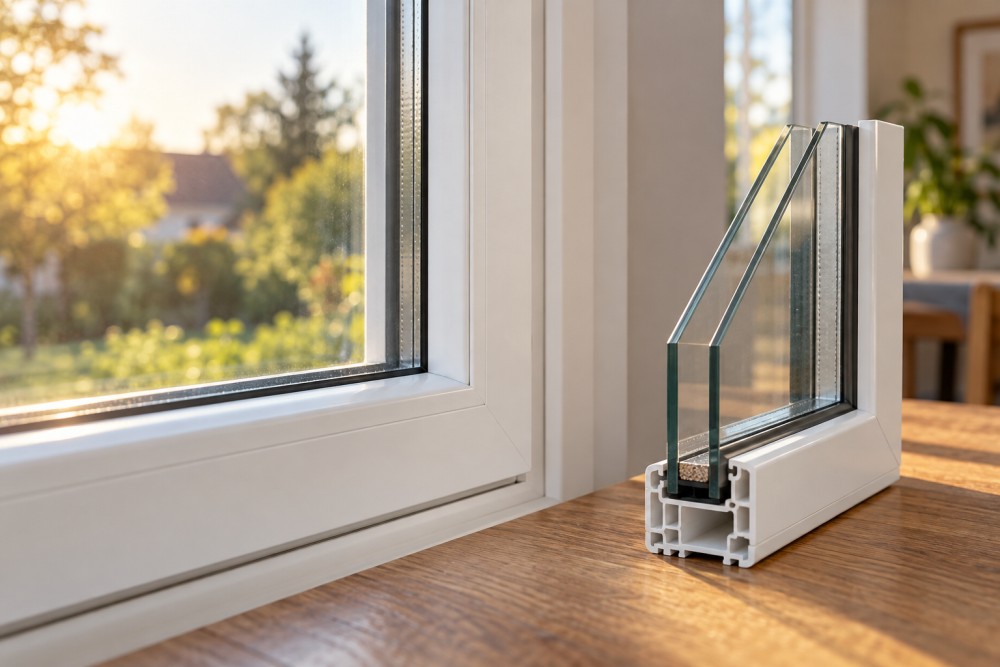
Does triple glazing automatically win?
Pane count is useful information, but it is not a substitute for the actual ratings. Compare the complete proposed assemblies, including their coatings, frame design, and configuration.
Triple glazing may be worth exploring when you prioritise reduced heat loss and comfort near the glass. Ask what improvement the quoted upgrade delivers, what it costs, and whether there are any differences in operation or appearance. Do not assume a specific payback period without a calculation suited to your home.
Check certification for the product you are buying
If a quote specifies ENERGY STAR® certification, ask for the exact model and configuration information and confirm it against the Canadian searchable product list.
Certification is a product-performance qualification. It does not, by itself, establish a rebate entitlement or guarantee a particular reduction in your utility bill. Those questions require their own verification.
Keep installation in the comparison
A well-rated product still needs an installation suited to the opening. Ask what removal, preparation, air sealing, finishing, and disposal are included. If the existing frame is being retained, confirm how its condition will be assessed.
Make sure both quotes cover the same work. A lower product price and a lower installed project price are different comparisons.
A short checklist for your next quote
- Exact window style, dimensions, and glass package.
- Whole-window U-factor in consistent units.
- SHGC and ER where provided.
- Certification details for the selected configuration.
- Interior and exterior finishes.
- Installation scope and any exclusions.
- Written product and installation warranty terms.
Keep a copy of the final specifications with your order. If a component changes before production, ask whether the performance information changes too.
Compare options with Alpha Windows
Start with the Alpha Windows estimator to explore your project, then ask our team to confirm the ratings and installation details for your chosen configuration.
The goal is a clear comparison: the right product for your rooms, an understood installation scope, and performance information that matches what you are ordering.