Key takeaways
- Describe the noise source and the room before choosing a window.
- Ask for acoustic test information for the proposed complete assembly.
- Plan installation details and ventilation alongside the window specification.
Can New Windows Reduce Traffic Noise? What to Ask Before Replacing Them
When cooler weather brings more time indoors, road noise can become hard to ignore. A street-facing home office may pick up passing buses, while a bedroom faces a steady evening flow of traffic.
Replacement windows may be part of a quieter-room plan. The useful starting point is a careful discussion of the sound, the existing opening and the proposed product—not a promise that new glass will make the room silent.
Describe what you hear
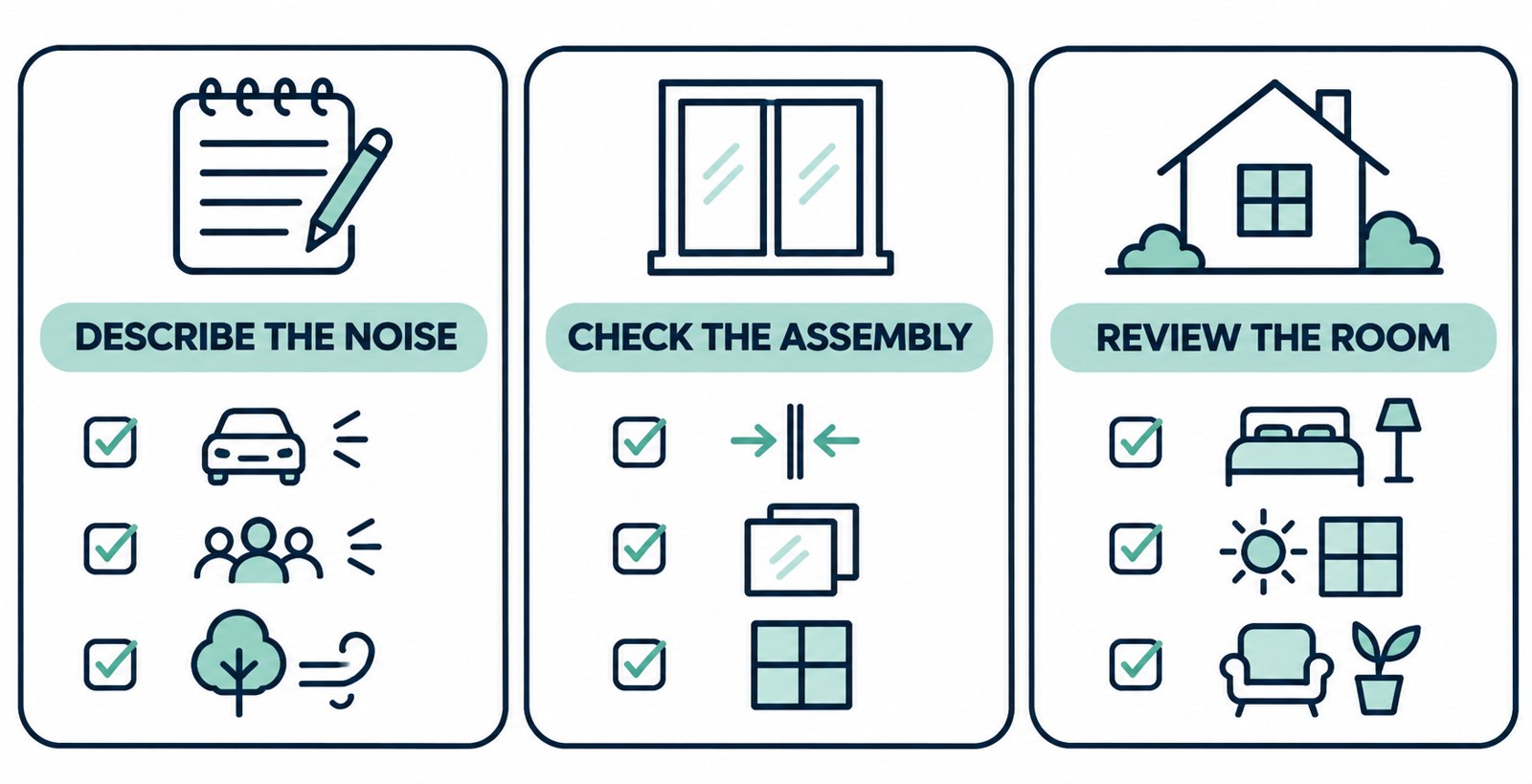
Before requesting a quote, keep a short record for several days. Note which room is affected, when the noise occurs and whether it is a steady hum, occasional engine rumble or a sharp passing sound.
Record whether the window is fully closed and latched during normal use. Tell the assessor about obvious operating problems, damaged seals or noise that seems strongest near another part of the room.
A recording can help explain the concern, but a phone recording or app reading is not a substitute for a professional acoustic assessment. Use it as a conversation aid rather than a product-performance target.
Look beyond the glass
Sound can reach a room through more than one part of the building. The City of Vancouver’s Noise Control Manual discusses windows, doors, vents and other weak links in an exterior wall.
That matters when deciding where to spend your renovation budget. A window upgrade cannot, by itself, resolve sound arriving mainly through another path.
Ask for an assessment of the opening, seals and surrounding construction before assuming that a different glass package will solve the concern.
Ask for acoustic evidence for the proposed window
Ask whether acoustic test information is available for the complete proposed window assembly. A description of a pane of glass does not necessarily describe a finished window with its frame, sash and seals.
You may encounter Sound Transmission Class, or STC, in test documentation. It is a rating used to summarise sound insulation performance. Have the supplier explain the test, the tested configuration and how closely it matches the unit being quoted.
Do not turn a rating into a promise that every passing vehicle will sound a particular amount quieter. The noise source, the room and other transmission paths also matter.
If there is no applicable test report, ask the supplier to say that clearly. A transparent limit is more useful than an unsupported percentage claim.
Keep energy performance and acoustic performance separate
A window can be selected for several reasons: heat-loss control, solar gain, operation, appearance and sound insulation. Evidence for one goal does not automatically establish performance for another.
The Vancouver manual distinguishes thermal insulation from sound insulation. Avoid using an energy label or the number of panes as a substitute for relevant acoustic information.
For the energy side of your comparison, see our window ratings guide. Keep the acoustic questions as a separate part of the quote review.
Discuss seals and installation
Ask how the proposed installation will address the connection between the new frame and the surrounding opening. Have the supplier explain what is included in the scope and what existing components will remain.
If the current window does not close reliably, ask whether service is a reasonable first step. Our drafty-window assessment guide explains how to organise observations before deciding on repair or replacement.
Do not dismantle seals or fill unfamiliar openings as a noise experiment. Have the installer identify their purpose and the appropriate treatment.
Plan ventilation at the same time
A closed-window acoustic discussion needs to include how you intend to ventilate the room. Ask how the plan works in warmer weather and during everyday occupancy.
Ontario’s environmental noise planning guideline recognises that ventilation openings can affect a façade’s sound isolation. It is a planning reference, not a ready-made specification for an individual replacement project.
Do not block a required vent or compromise an opening’s intended safety function to reduce sound. Ask the appropriate professional to coordinate ventilation and acoustic needs.
Know when to request a specialist assessment
Consider an acoustical consultant when noise is the main reason for a substantial replacement project, when low-frequency rumble is particularly troublesome, or when a specific indoor result is essential.
Ask what assessment is appropriate and whether it should happen before the product is selected. A supplier can explain its available products; a site-specific acoustic assessment addresses the broader room and building.
Questions to bring to your quote review
| Ask | Why it helps |
|---|---|
| What is the likely sound path? | Keeps the recommendation tied to the room |
| Is there relevant testing for this complete assembly? | Separates evidence from general claims |
| What installation work is included? | Clarifies the treatment of the opening |
| How will the room be ventilated? | Connects the specification to daily use |
| What result can reasonably be supported? | Sets clear expectations before ordering |
Start with a clear brief for Alpha Windows
Share the room, street exposure, noise observations and any professional recommendations with the Alpha Windows team. Ask which configurations are available and what relevant performance information can be supplied.
You can use the Alpha Windows estimator to explore a starting layout, then confirm the final product and installation scope with the team.
A useful noise-reduction plan starts with the right questions. Clear evidence and a realistic scope make the next decision easier.